
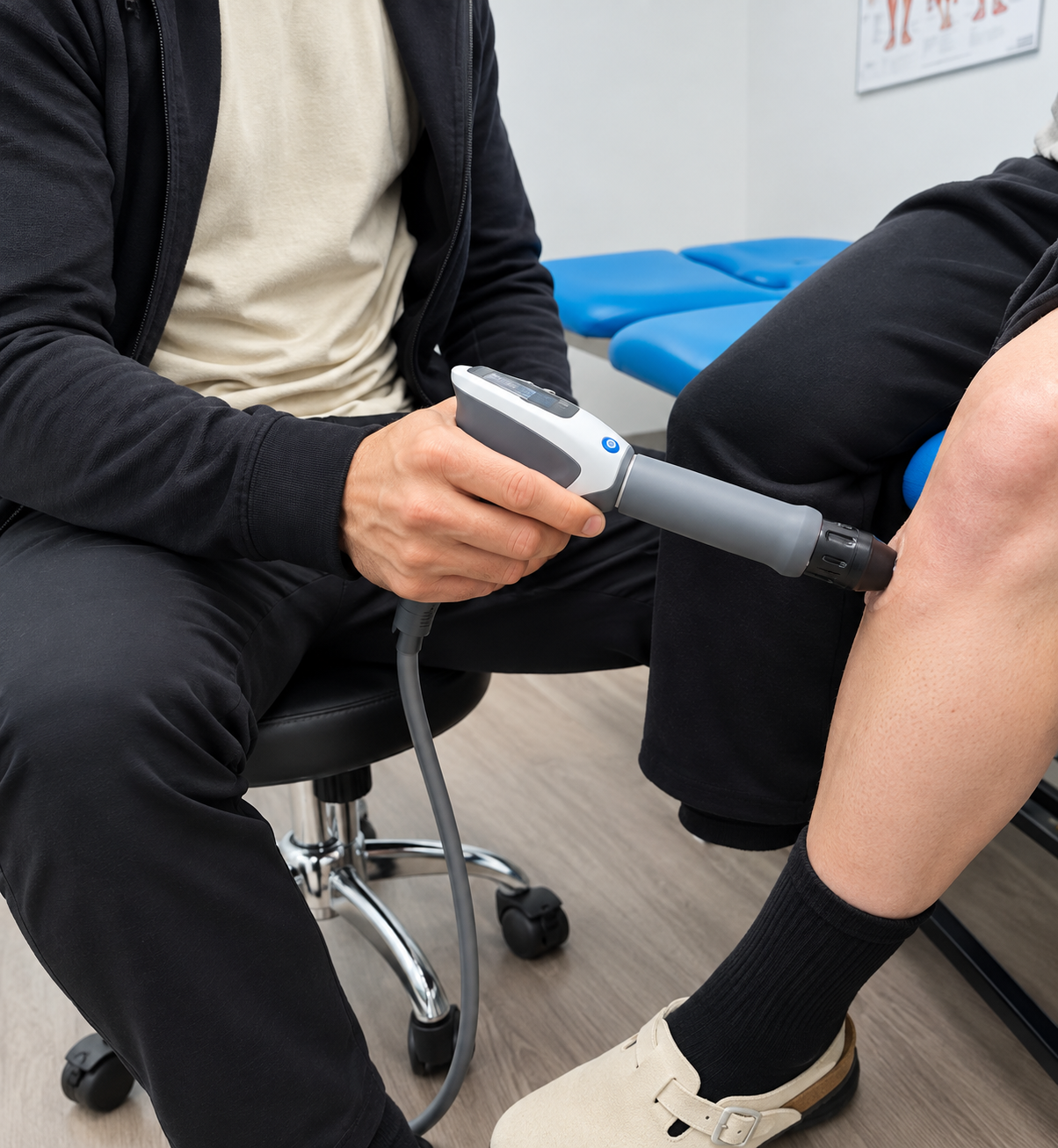
Radial shockwave is a non-invasive treatment using acoustic pressure waves. It may be considered for persistent tendon, muscle and other musculoskeletal conditions when conventional care has not produced the expected progress.
An assessment determines whether shockwave is appropriate. Your practitioner adjusts the application to your symptoms and may combine it with exercise, manual therapy and rehabilitation.
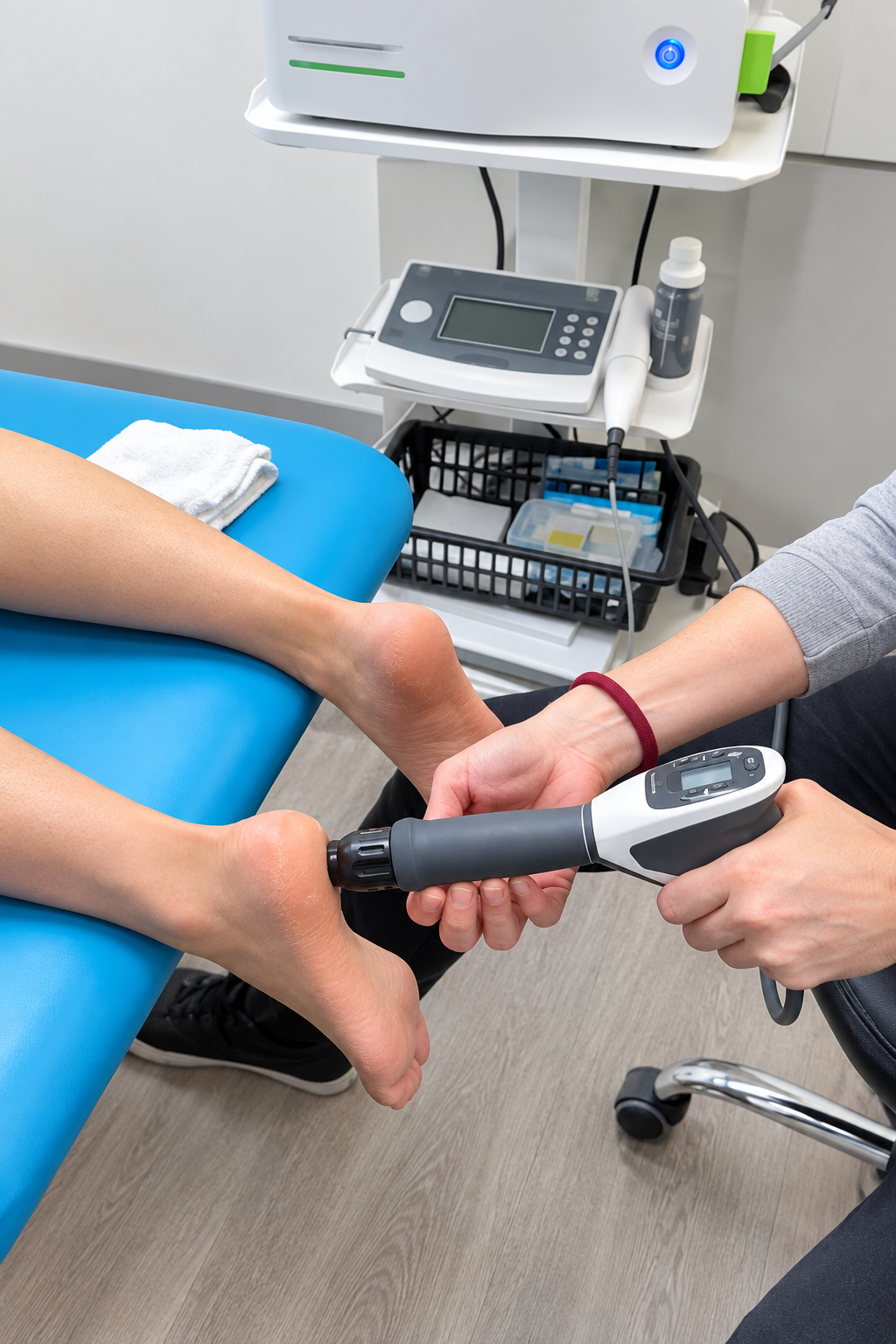
Treatment targets the affected tissue, with intensity adjusted to the condition, location, sensitivity and your response.
TARGETED RADIAL SHOCKWAVE
Radial shockwave delivers pressure waves through a handheld applicator to the targeted treatment area. The location, intensity and duration of treatment are adjusted according to the tissue involved, your symptoms and your tolerance during the session.
WHY SHOCKWAVE IS USED
Radial shockwave is commonly considered for persistent musculoskeletal problems, particularly certain tendon and soft-tissue conditions. It provides another treatment option when symptoms have persisted or progress with other conservative approaches has been limited.
SUPPORTING THE HEALING RESPONSE
The mechanical stimulation produced by radial shockwave interacts with the treated tissue and may influence biological processes involved in pain modulation, circulation and tissue repair. This is one reason shockwave is often considered for persistent tendon and soft-tissue problems that have been slow to improve. The goal is to stimulate a response in the affected tissue while creating an opportunity to progressively restore strength, movement and function.
WHAT TREATMENT FEELS LIKE
During treatment, you will feel a series of rapid pressure pulses over the targeted area. Sensitive or injured tissues can feel uncomfortable, but treatment intensity can be adjusted throughout the session based on your tolerance. A treatment application is relatively short, and your practitioner will communicate with you throughout the session to keep the intensity appropriate.
YOUR COURSE OF TREATMENT
Radial Shockwave Therapy is typically provided as a course of 3 to 5 treatments, with sessions commonly spaced about one week apart. The exact number of treatments depends on the condition being treated, how long symptoms have been present and how you respond. Progress is reassessed throughout the treatment plan, and recommendations can be adjusted based on your response. Improvement may occur gradually during the course of care and can continue after the treatment series as the tissue responds over time.
SHOCKWAVE + REHABILITATION
Shockwave is most useful when it forms part of an appropriate treatment strategy rather than simply treating the painful area and sending you home. When needed, care can incorporate progressive loading, strengthening, mobility, movement retraining, activity modification and manual therapy. This allows treatment to address the affected tissue while also rebuilding its capacity to tolerate the demands of work, exercise, sport and everyday activity.
Shockwave may be considered for the following persistent tendon and soft-tissue concerns. Your practitioner will assess suitability and explain how it fits into your treatment plan.
FOOT, ANKLE & HEEL
Plantar fasciitis / plantar fasciopathy • Plantar heel pain • Chronic heel pain • Achilles tendinopathy / Achilles tendonitis • Persistent Achilles pain • Certain persistent foot and ankle soft-tissue conditions
KNEE & LOWER LEG
Patellar tendinopathy / jumper's knee • Persistent patellar tendon pain • Certain chronic calf and lower-leg soft-tissue conditions • Persistent tendon and soft-tissue pain around the knee
HIP & THIGH
Greater trochanteric pain syndrome • Gluteal tendinopathy • Persistent lateral hip pain • Proximal hamstring tendinopathy • Persistent hamstring tendon pain
SHOULDER
Rotator cuff tendinopathy • Calcific rotator cuff tendinopathy • Persistent tendon-related shoulder pain • Certain chronic soft-tissue conditions around the shoulder
ELBOW, FOREARM & WRIST
Tennis elbow / lateral elbow tendinopathy • Golfer's elbow / medial elbow tendinopathy • Persistent elbow tendon pain • Certain chronic forearm and wrist tendon conditions
MUSCLE & SOFT-TISSUE CONDITIONS
Persistent muscle and soft-tissue pain • Myofascial pain and trigger points • Areas of muscular tightness and restriction • Certain chronic soft-tissue injuries that have been slow to improve
OTHER PERSISTENT MUSCULOSKELETAL CONDITIONS
Radial shockwave may also be considered for other persistent tendon and soft-tissue conditions following assessment. Not every painful condition is appropriate for shockwave, so identifying the tissue involved and determining whether radial shockwave is suitable are important parts of treatment planning.
Our team considers shockwave within a broader recovery plan, guided by assessment and your rehabilitation needs.
EXPERIENCE WITH MUSCULOSKELETAL INJURIES
Our clinical team works extensively with musculoskeletal injuries, persistent pain and activity-related conditions. This experience helps ensure that shockwave is considered in the context of your actual diagnosis and physical demands, not simply because an area is painful.
A TEAM BEHIND YOUR RECOVERY
Momentum brings physiotherapy, chiropractic, athletic therapy and massage therapy together in one clinic. When your recovery would benefit from another clinical perspective, rehabilitation approach or hands-on treatment, that expertise is available within the same team.
BUILT FOR ACTIVE PEOPLE
From everyday activity and physically demanding work to recreational and competitive sport, we understand that recovery has to prepare your body for what you actually need it to do. Your treatment plan can be progressed with those demands in mind.
KNOWING WHEN SHOCKWAVE ISN'T THE ANSWER
Not every injury or persistent pain problem is appropriate for radial shockwave. Part of good care is recognizing when another treatment approach, further assessment or referral may be more appropriate for your condition.
Book an assessment to find out whether radial shockwave is appropriate and discuss your treatment options.


